On The Ganges

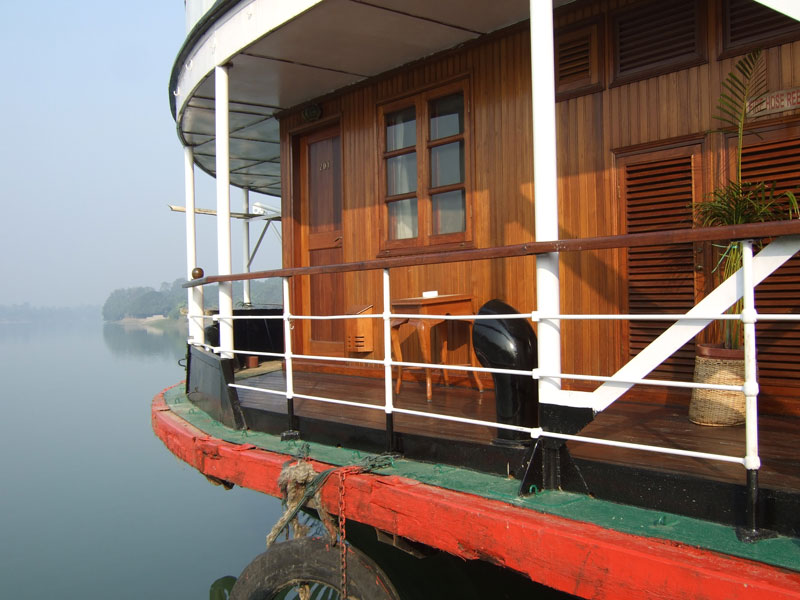
It’s a misty, cobalt coloured dusk and I’m out in the middle of the Gangetic plain, a place not normally visited by tourists. From the top deck of the beautiful river cruiser, I look around 360% and, apart from the little yellow light from our pilot boat, which comes through the blue-grey haze like a distant candle, I can see no electric light in any direction to a flat wet horizon. No sound but lapping of water and the occasional chitter of some wading birds taking flight.
On the jetty below, the crew have taken the time out from their work to prepare a small ceremony to bless our voyage. The time is auspicious for a blessing, so a small fire has been lit and some mats laid out. A statue of Ganesha, the elephant-headed god of removing obstacles, has been found, and presides. A priest starts to chant and the suited travel tour operator, Mr Singh, joins them on the mats. The priest ties a little cord around Mr Singh’s wrist and each of the crew members throws a small flower into the fire.
I make no excuses for choosing what I thought was going to be the lazy, luxurious way to see north eastern India. Having been to India before on my own steam, I know only too well how much hard work it can be to achieve quite simple things like buying a train ticket or arriving anywhere on time. If you don’t mind being herded around a little bit, I thought, then a luxury boat, gliding along the Ganges from Kolkata to Varanasi, with five star cuisine, is definitely the way to go. However, I hadn’t taken into account certain obstacles, such as the fact that the Ganges, although two kilometres across in some places actually only has a navigable channel a few yards wide, so a small gust of wind can easily blow one onto a sandbank. Add to this the fact that the sandbanks don’t necessarily stay in the same place from one week to the next and you are on an adventure; not sure which town or village you will be visiting the next day. This turned out to be a very exciting and unusual trip.
The boat company has only been in operation on the Ganges since October 2009 and before that, there have been no tourist boats since the 1920s, so we were pretty much covering new ground. And we were virtually alone on the river; there is no other motorised river traffic, industrial or otherwise – the occasional gondola ferry packed with standing villagers, animals and bicycles, or a barge, top-heavy with hay. Five nights and days drifting up the Hoogli and Bhagirathi rivers, then turn left at the Farrakka lock and a further five nights on the Ganges proper.
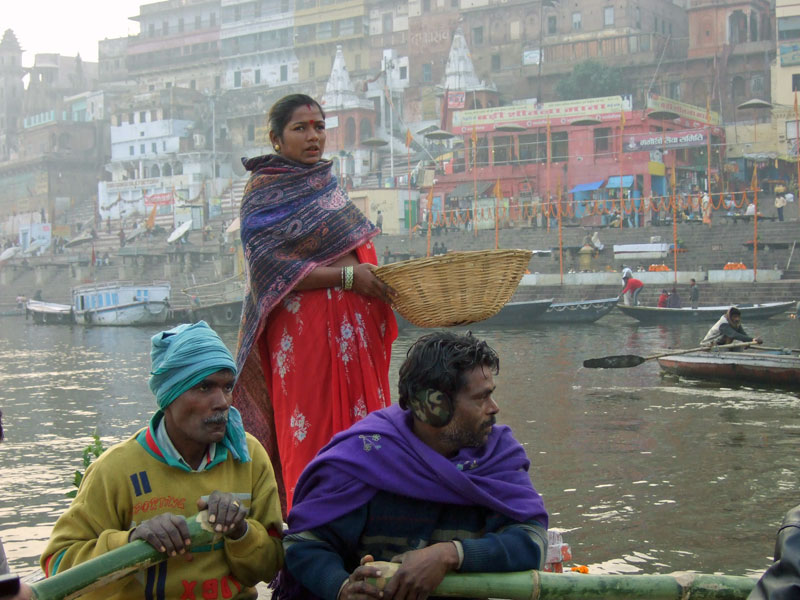
As we floated past rustic villages, the schools emptied and children ran down to the shore to catch sight of us, all shouting ‘Tataaa! Tataa!’. Some afternoons, the tataa-ing was non-stop. Old steps lead down to the water’s edge from every village and people were bathing daily in the river, performing their ‘puja’, or morning prayer, others were slapping their washing on rocks and laying out their multi-coloured saris and silks to dry; cerise, turquoise, saffron, marigold, fuchsia – the colours look as natural in this pellucid light as the blue flash of a kingfisher or the green of a bee-eater. The bird watching is of course, spectacular in this massive wetland, and, with the help of Rajveer and Balbo, the on-board naturalists, we spotted over 40 species in a single day, as well as rare, smooth-backed otters, jackals and plentiful sweet-water dolphins.
At the bottom of the same steps, or ghats, were the cremations. The dead are brought to the side of the river wrapped in orange and white, and burnt on a wood pyre, then their ashes scattered into the holy water of the Ganges. Sometimes the mourners were silent, sometimes there was a clashing of cymbals and jolly singing and dancing. Often we passed piles of smoking embers with a few discarded bits of orange and white material lying around among the marigolds and burnt wood. Mother Ganges, who rides on a crocodile and also is manifest in the tangled hair of Shiva, is the holiest of rivers and it was a privilege to drift along the water, letting her dictate the speed and time-table of our journey.
It was also a privilege to be visiting some of the villages and towns we went to. Because of the river access we were able to get to places where the sight of people like us was a novelty; we were the day’s entertainment. Although some of these places scarcely had cars nor roads, and their electricity was often supplied by a local generator or from a single overhanging cable, (of which more later) many villagers did have mobile cam-phones and weren’t shy of using them. For every group of giggling girls, or boy showing off in front of our telephoto lenses, there were other villagers holding their mobiles up to capture footage of us; the strange, lumbering creatures, the tourists.
We visited a village given over to hand-loom weaving, where twine is laid out on bamboo sticks for thirty yards across the forest floor, another whose chief occupation was smelting and engraving brass jugs and plates from scrap metals; the sound of hammer on metal came from every house and could be heard from half a mile away down river. One village’s speciality was rolling ‘bidis’, the small Indian cheroot made from bitel leaf. On every corner of this village sat women with trays on their laps, their fingers spidering a thousand bidis a day out of the piles of bitel leaves and tobacco. In another village, gangly men shinned high up into palm trees and came back down again with buckets strapped to their waists full of ‘toddy’ spirit tapped from the tree.
But the trip was not entirely rural; as well as the obligatory coach tour round Kolkata on the first day, there were rickshaw rides to temples, towns and museums throughout West Bengal and then Bihar. Memorable among these visits was a day at Murshidabad and its palace, now a museum. Nearby is the site of the battle of Plassey, which established Robert Clive as the first governor general of Bengal, and also made him a very, very rich man.
Before the spectacular finale to our trip, the last night in Varanasi – where we dined in a candle-lit waterside palace, witnessed a night time drumming ceremony from the water, saw some Indian classical dance, and made a wish as we floated small candles nestled in Marigolds and lilies from our boat – we had one more extraordinary place to visit; Bodh Gaya, the place where the Buddha became enlightened while sitting under the Bodi tree, and now a magnet for Buddhists internationally. I had always romantically imagined that this would be a peaceful spot on a hillside, bathed in clean light, where an atmosphere of calm and reflection might prevail. It became quickly obvious that this was as naïve as imagining the Vatican to be a place of austere contemplation and renunciation. The place was heaving. Leaves ostensibly taken from the tree itself were on sale in plastic bags for 100 rupees a pop, westerners and easterners alike were prostrating themselves in front of the garishly decorated idols, many were overcome with bouts of impassioned chanting and beggars in extreme states of deprivation were practiced enough at their hustle to make even the most sensitive soul harden just to be able to move another few inches down the street. There was a lot of religion there, but not a lot of charity.
I’m sure that Ganesha, the elephant-headed god of removing obstacles had to work overtime during our trip. Particularly in Bihar where we were accompanied by tourist police at all times. The boat company have experienced some rather typically Indian teething problems in their first few attempts at the Ganges; apart from the afore-mentioned grounding on shifting sandbanks, they have had to deal with freak cold snap weather with blinding fog and no heaters on board, the boat short circuiting the electricity supply of an entire town by colliding with a low hanging electricity cable, and most appropriately, a clay and straw statue of Durga, mother of Ganesha, getting caught in the propeller and mangling it. ‘These things have to be done with the heart you know,’ said Mr Singh, smiling, as he climbed back on board after the crew’s auspicious blessing ceremony on the jetty.
It sounds like a cliché, I know, but I felt that this trip gave me a taste of the real India. For a traveller interested in culture, history and wild life, as I am, it was a unique experience. In fact on my return home, I went straight to the computer to see about booking a return visit.