Marquesa Islands

There are some places in the world which seem to have appeared in your recurrent dreams since childhood, so that actually going there gives you a strong sense of deja vue. Everybody has such a place, I reckon, probably first glimpsed in a big cardboard picture book in the days when the printed word still looked like nasty black maggots on a page. For some this Pavlovian reaction might be stimulated by a Bavarian castle in magic mountains, for me it has always been a rugged and jungle-clad desert island.
I have often tried, unsuccessfully, to fulfil this childish fantasy by visiting island groups from the Canaries to the Caribbean. But even the Seychelles and the coast of Northern Australia lacked the unreality and the magic of the original childhood imprint. Which is why, for me, the trip of a lifetime had to be a visit to Polynesia.
The Marquesas are the island group furthest in the world from a land mass. Planet earth is blue mostly because of the Pacific ocean which covers a third of it and the Marquesas are the most remote archipelago within that vast expanse of water. To get there takes rather a long time. Firstly, you have to get to get to Tahiti, which, from Europe, means wearing double thickness thrombosis socks for the two long-haul flights, back to back, via Los Angeles. Add to this the two days at sea that it takes, via the Tuamotu islands, from Papeete, the port of Tahiti, and you?re looking at the best part of a week to get to Nuku Hiva, the main island of the group.
Although there are now a couple of landing strips on one or two of the islands, if you want to visit all of them, the only way to go is by boat. And they are all worth visiting. From the astounding deep valley on Fatu Hiva, where Thor Heyerdal conceived his now discredited theory about the origins of the Maori people and launched his Kon Tiki raft, to Hiva Oa, where the big Tiki statues are second only to those on the Easter Islands. Each has breath-taking scenery – palm covered pitons which plunge into the sea at their bases and poke up into the low-lying clouds above. The climate is temperamentally tropical and the vegetation is overwhelmingly luscious; apart from the ubiquitous cocoa-nut palm and bread-fruit trees, there are giant banyan – or ‘upside-down’ trees whose root-like tentacles drop from its branches to the ground like vast drinking straws. Aromatic flowers are every where – bougainvillea, frangipani, hibiscus, gardenia, and tiare – which is the one they put over their ears, and yours every time you arrive on a new island or even enter a supermarket. This is where Gauguin escaped to when he found Tahiti too commercialised, and the title of his famous note and sketch-book about the south seas is „Noa Noa?, which means scent, or exotic aroma. Another thing which no doubt must have attracted Gauguin here, apart from the abundant supply of beautiful women to paint, is the light. At this latitude it has a lambent and unreal quality to it – extreme, white sunshine and deep, purple clouds are capable of co-existing in the same moment. All of this served to increase my feelings of subliminal connection with some buried childhood memory. And that’s before mentioning the endless horizons of water and the unsurpassable sunsets.
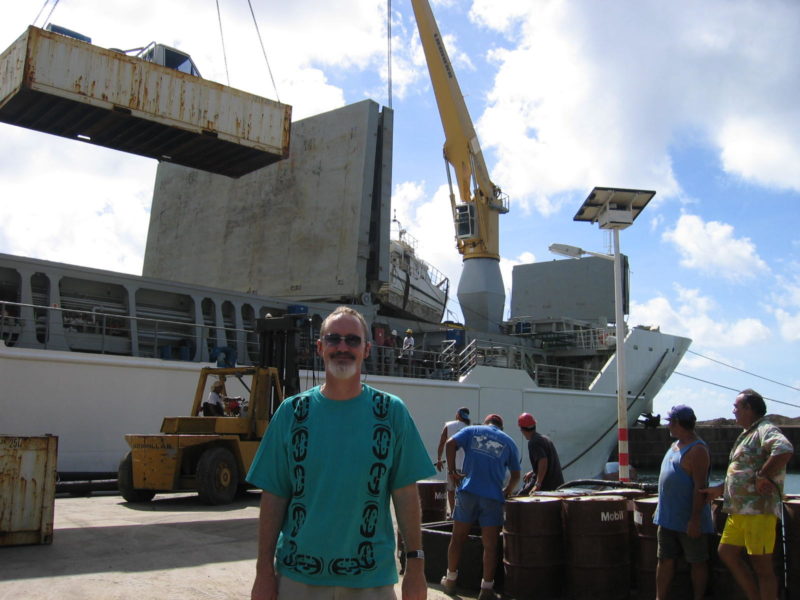
The Aranui is the only regular cargo ship to service the Marquesa islands, if not the only ship to go there at all. Once every three weeks it visits each of the islands of the archipelago dropping off supplies; four-wheel drive geeps, diesel and cans of baked beans, and picking up sacks of limes, dried cocoanut, or „copra?, and crates of empty beer bottles. But it is also a passenger taking cruise ship with a small staff of guides, a sunning deck and a mini swimming pool. The two week voyage round the Marquesas on the Aranui is a unique experience; neither a luxury cruise with dancing and dressing for dinner, nor a stowed passage in cramped quarters by the engine room. Although members of the crew, most of them Marquesan, often eat with the passengers, the restaurant is by no means a works canteen and the Aranui brings with it not only its own chef, but its own patissiere. The food was good and the quality of the wine on the table, like water with every meal, did not allow me to forget for one moment that I was in French Polynesia.
The Aranui takes between fifty to a hundred passengers, most of them French, a smattering of Americans, no English. In fact I did not meet another British person for the entire duration of my trip. A good tip for any visit to Polynesia, but essential on the Aranui, would be to brush up on your French, with particular attention to the phrase; ‘je ne suis pas Americain’.
The Aranui weaves its way round the island group, visiting all but two of the islands, calling on some twice. A typical day starts with embarkation at a new island, having been briefed the night before about what has been planned for the day and the level of noo-noo trouble to expect – a noo-noo being a particularly fierce Marquesan mosquito; I am one of those annoying people with zero interest from mosquitoes, so I was free to ignore this advice. To get ashore meant clambering down the tilting gangplank into the wooden whaleboats. Sometimes, in a choppy sea, this meant older passengers being swung up into the tattooed arms of one of the enormous piratical crew members and laid down gently on the quayside.
The day?s activities might include a walk, a picnic, a swim in the sea, a visit to the local church or archaeological site, and always included a visit to an arts and crafts workshop, with an opportunity to buy local wood carvings and bead jewellery. Like the cynical Londoner that I am, I refrained from buying any of these artefacts and it was only on returning that I realised my mistake, for these unusual pieces of dark polished wood are exceptional and not typical tourist items.
Until the Marquesan „Rennaissance? in the 1970s, the recent history of the culture and traditions of the Marquesans has been, unfortunately as sad and shameful as that of the American Indian or the Australian Aboriginal people. Before what is known as “The Fatal Impact” of white explorers, traders and missionaries – who brought alcoholism, disease and loss of autonomy – the Marquesans had lived in a series of warring villages with a strong tradition of tattooing, bloodthirsty combat and cannibalism, which survived even into the first decades of the twentieth century. They believed that if you ate someone, you inherited their life force and so used to go out and catch a couple of neighbours to eat for family events such as the birth of a new child or a wedding, or they might keep them alive until such an occasion occurred. They had no fridges.
Since the seventies and the injection of vast quantities of French, post nuclear-testing compensation, they do all have fridges and seem also all to own four wheel drive vehicles; the Polynesians are said to be the most subsidised people on earth. However this does not make for a lot of traffic, as several of the islands have populations of merely a few hundred. Their dark black hair and eyes, and buck teeth make them charismatic, even a bit scary. They are invariably tattooed, often over the face; in fact the Marquesas is the home of the ceremonial tattoo. The men and the women tend to have the build of Rugby players and their national dances – performed at the slightest opportunity in restaurants and on quaysides – resemble a cross between a Hula dance from an Elvis Presley movie and the all blacks Maori chant.
Apart from Hiva Oa – which as well as the Tikis, has the distinguishing features of the graves of both Gauguin and the Belgian singer, Jaques Brel, – after a week or so, the islands started to melge into one homogeneous fantasy super-island, particularly since we revisited some of them, or went to different bays on the same island. The whole experience had become dreamlike. As we called in on Ua Pou, the last island on the itinerary, I remember thinking, did I visit this place in my childhood subconscious, or was it last Thursday?