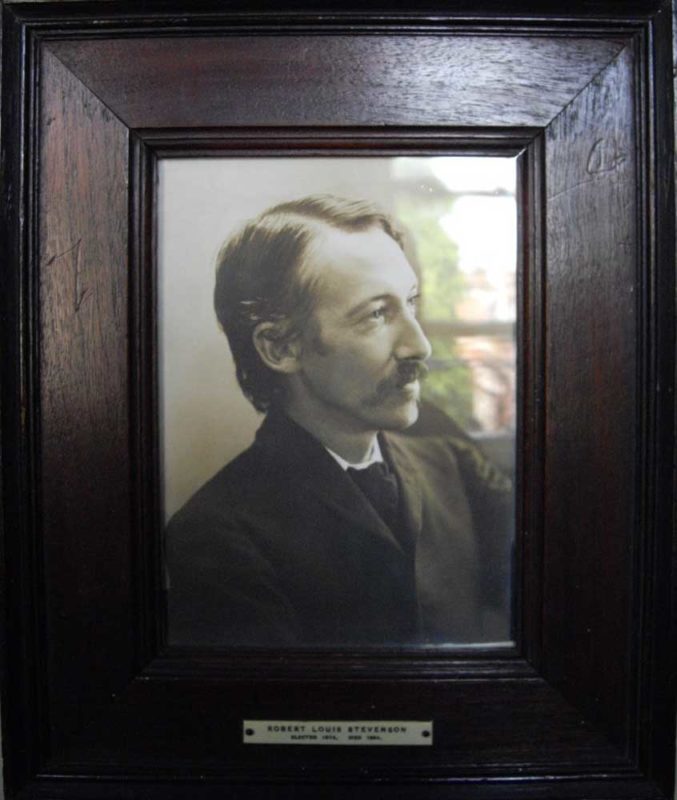
Western Samoa
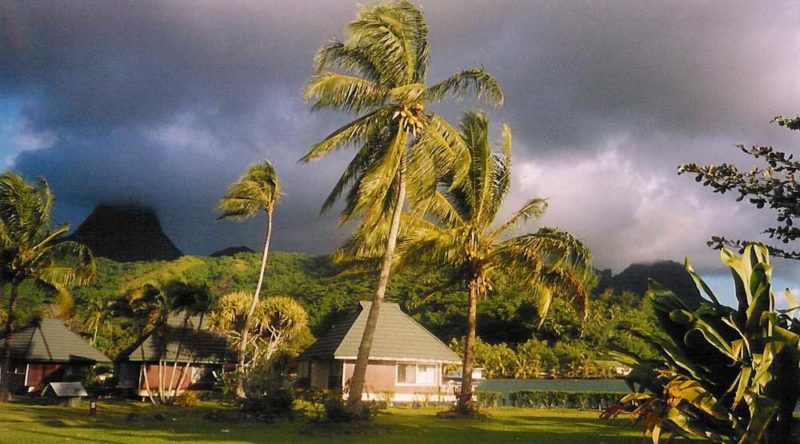
The climb up through the steaming tropical forest had already taken forty five minutes of scrambling through – and under – the roots of enormous Pandanu trees in the body-hugging heat, with still no sign of sunlight ahead; and this was meant to be the short-cut. Half an hour to the top, the painted sign had said. No matter how many times I had read that there are no venomous snakes and insects in Polynesia, the rustling and fluttering all around me was beginning to worry. And the sticky spider’s web I had walked through a few muddy slopes back, had somehow managed to work its way right inside my shirt. I stopped to drink the last of my water and curse Robert Louis Stevenson for being so obtuse in his choice of final resting place. The strange-looking black bird with white bushy eyebrows, which had been dancing ahead of me for the last few minutes, stopped also. Was it some kind of ominous Robin of the south seas who lured travellers to their certain death? There were disconcerting high-pitched screeches from branches, stretching and scraping against each other deeper in the forest which, had I not read my Stevenson’s ‘Tales of the South Seas’, I could have mistaken for the groans of dead sailors who had been boiled in pots and eaten by tattooed islanders.
None of these alarming sights and sounds would have daunted Stevenson, whose real life was more danger-filled and romantic than any of the adventure stories he wrote. Although his historical fiction still fills several shelves of most bookshops nowadays, Stevenson’s contemporary travel writing has been somewhat ignored. This could be because in his late thirties, he abandoned Europe altogether and literally buried himself in the south Pacific – acquainting himself with the languages, religions and social mores of most of the different island groups of Polynesia and even, at one point, becoming personally involved in an inter-tribal war. His vast reading public would have preferred him to continue churning out romantic adventure stories, his publisher would have liked him to come home. But a return to the chilly northern hemisphere would have meant a fatal decline in health for Stevenson, who had suffered from tubercular lung haemorrhages since early childhood. Not wanting to give up what he called the ‘gusto of existence’, he had set off on three consecutive and challenging voyages around the Pacific, before eventually settling in Samoa, where he lived for four years until he dropped dead suddenly, and ironically, of a brain haemorrhage at the age of forty four. In these last six years of his life, his output remained prolific; often writing from his sick-bed or from the deck of a ship, he penned close to a million words – the equivalent of four large Russian novels or twelve Nick Hornbys.

The South Pacific is not the easiest of places to get to – two long-haul flights back to back at the very least – and the distances between island groups once there are vast; Samoa to Tahiti, for example is roughly the equivalent of London to Moscow. But in Stevenson’s day it was considerably harder and considerably more dangerous. There were still uncharted reefs to negotiate in the Tuamotu islands and, if one managed to survive the temperamental weather, the people on the islands might prove hostile. On arrival in Nuku Hiva in the Marquesas on the first of his south sea voyages in 1888, Stevenson’s ship was over-run with tattooed warriors wielding clubs, and his subsequent fear of being killed and eaten was well-founded; cannibalism had not fully disappeared by the 1890s. So my concerns about whether I had put on the right factor sun-cream that day, or whether I would be able to get a taxi back to the hotel after my descent from visiting his tomb at the top of Mt Vaea were, to say the least, rather pathetic.
Samoa is not your usual holiday destination, not for Europeans. As a holiday island it is the diametrical opposite of Ibiza. For a start, there are virtually no holiday-makers and nothing that we jaded northerners would recognise as nightlife. No beach and body culture, no thongs, no rave scene, no time-share. What it does have is great physical beauty. Gentle, forested mountains rise away from a wiggly coast line of empty, palm-fringed beaches. All along the coast road are neat villages made up of corrugated-iron roofed bungalows, many of which, in the Samoan style, have no walls at all. Their raised concrete platforms and supporting beams make them look rather like oblong bandstands. Whole extended families – from grandparents to babies – house under one roof, exposed to the air, and the gaze of passers by. At night this creates an outlandish effect, since many do have furniture, television and fluorescent lights. In the daytime, wild pigs run around in the road, people wash in the streams close to the shore and the gaudily painted buses drop off hordes of children in neat, church-school uniforms. There are seemingly endless churches, all with corrugated-iron roofs – congregational, catholic, Presbyterian, Methodist, protestant, Anglican – I counted four in a row in one street. Most local music seems to be of the ‘Michael row the boat ashore’ variety, rather than the Euro dance-mix we have come to associate with sunny weather.
The entire island group of Western Samoa has a population of under a quarter of a million people, so there is room to move. Not that the Samoans seem to do a lot of that. Why bother, when you can reach out from your open-plan home and pick bananas and papaya from the extensive and communal orchard? Apart from one extremely ugly ten storey bank, there are no tall buildings in Apia, the capital and port of Upolu, and main island of the group. In fact, the town sprawls so gently across the bay that it is hard to see where it begins and ends at all. There are no cruise ships in its harbour, only one or two bobbing yachts in the bay, and, a mile or so out to sea, the thin line of surf at the edge of the reef makes a noise like distant running trains. ‘The ceaseless requiem of the surf hangs on the ear’, as Stevenson put it.
Samoa has a confusing provenance, having been fought over and abandoned by the English, the Americans and the Germans. Independence was fought for and won in the early nineteen sixties and so now what was called Western Samoa is Independent Samoa, and not to be confused with American Samoa, another island group across the water where evidently they do have Macdonalds and videos and business centres and porn. In the meantime, Independent Samoa, though ten times less well off than its American neighbour has peace, quiet and dignity, and of course, it has Robert Louis Stevenson. Stevenson is still held in great respect by the Samoans, who called him ‘Tusitala’, the teller, or writer, of tales. He negotiated on their behalf against the colonial authorities on several occasions and in his South Seas fiction, the heroes and heroines are invariably native islanders struggling against what he called ‘our shabby civilisation’. When he died, they carried his body in a great procession to the top of the mountain to lay him to rest. How they managed that up this slope, I don’t know. Maybe it hadn’t rained so heavily the night before.
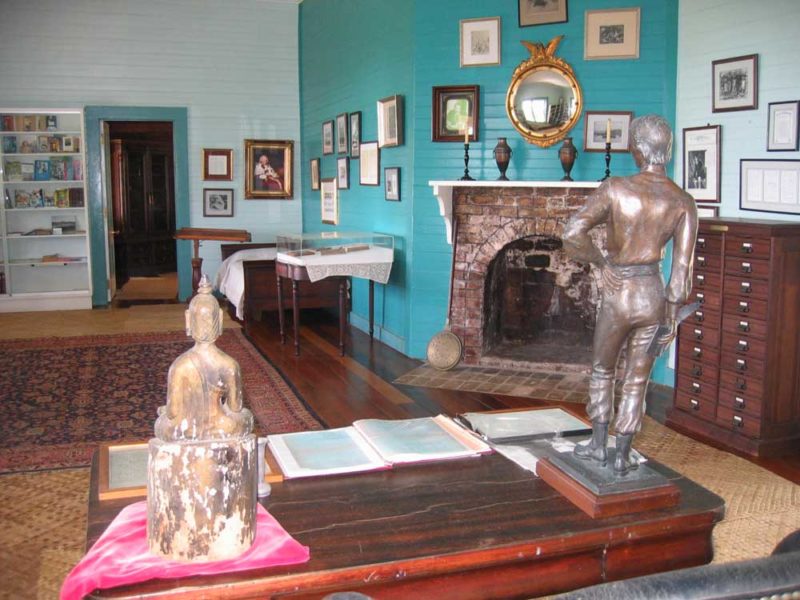
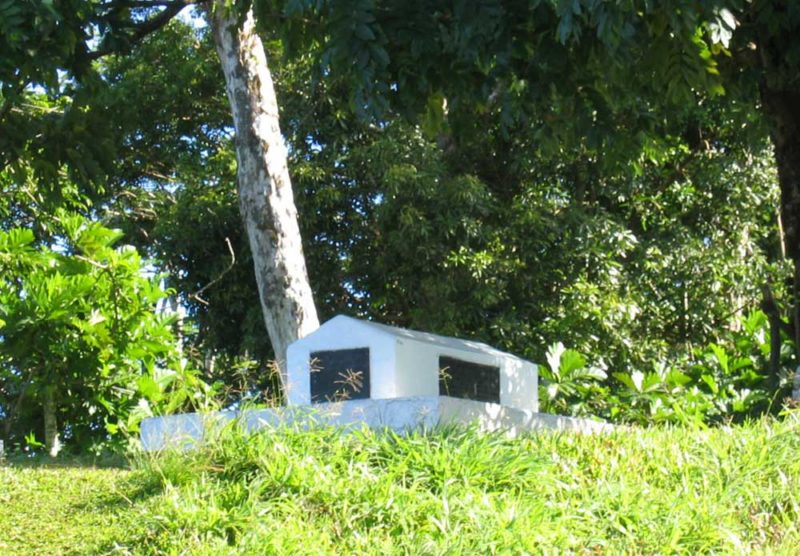
At last I emerged, panting and sweaty, onto the knoll at the top of Mt Vaea. To my right was a view of the ocean and Apia valley below; so spectacular it took away the last remnants of my breath. Below me, beyond the trees were the neat lawns and rooftops of Vailima, Stevenson’s house and estate, now lovingly restored and the home of the Stevenson museum, where you can walk through his study, see his tiny bed – incidentally in a different room from the large one of his wife Fanny – and stand on the exact spot where he dropped dead. The house is enormous because Stevenson was not a lone traveller. He was supporting a huge entourage of hangers on; not only his wife and her two children and her daughter’s spouse and child, but also his own mother. It was lucky for him that the sales of Dr Jekyll and Mr Hyde were still strong. I wondered if this spot he had chosen in which to be laid to rest, high up above the house, had been an often visited haven from the stresses of what must have been a very complicated household. I certainly felt that everyday reality had been left several hundred feet below me and quickly fell to contemplating the eternal.
As it happened, a taxi drove by at the exact moment I staggered out onto the road, filthy and dehydrated after my descent. There is not a huge selection of hotels to choose from in Samoa and by far the most well known, and most fun, is Aggie Grey’s. The taxi driver took it for granted that that is where I would be going. Aggie Grey is Samoa’s other celebrity and her hotel is like a living history lesson of Samoa in the twentieth century. When the American navy were stationed here during the Second World War, and the Samoan islands were legally speaking completely teetotal, Aggie Grey somehow managed to find alcohol to sell. She also did a good line in hamburgers and coffee for the servicemen from a stall on the sea front where the hotel now stands. It is said that James Michener based the character of Bloody Mary, the madam in his story that was to become the musical South Pacific on Aggie Grey, although both he and Aggie Grey have denied it. The hotel, like the rest of the island, is delightfully old-fashioned, most of the rooms are named after the movie stars who have stayed there. The fact that many of the names are those of bygone stars who shone before my time made me feel refreshingly young. Most of the guests are from New Zealand or Germany and in fact I didn’t meet another Brit on the entire trip, something which might not be to everyone’s taste, but which I very much enjoyed. But then of course, I had my return ticket and knew I would be shortly taking the double flight home. Stevenson we know, did not have this reassurance. He longed for home during his illness-inflicted exile. ‘I am a Scotsman,’ he wrote, ‘touch me and you will find a thistle. . . it is Edinburgh, that venerable city, that I still think of as home.’ In fact, he missed Scotland so much that he made his staff wear tartan sarongs and had homely brickwork fireplaces painted in ‘trompe d’oeil’ on the walls of his study and smoking room. Often in his writings post 1888 he searches for similarities between the south sea island landscape and that of the Highlands of Scotland; ‘I could have fancied that I had slipped ten thousand miles away and was anchored in a Highland lock’ he wrote of Atuona bay in the Marquesas. Having visited both I would say he was clutching at straws there, but knowing of his homesickness made all the more poignant the famous, inspirational words he had inscribed on his tomb at the top of Mt. Vaea;
‘Under the wide and starry sky,Dig the grave and let me lie.Glad did I live and gladly die,And I laid me down with a will.This be the verse you grave for me;Here he lies where he longed to be;Home is the sailor home from the sea,And the hunter home from the hill.’