Grand Canyon and Las Vegas

One is so used to the American tendency to big everything up, that occasionally the reality underwhelms. When everything is hyperbolically billed in grandiose terms – ‘The tallest building…’, ‘The largest grossing movie ever…’ one tends to expect an ever increasing stream of adrenaline rushes. As I flew in from Phoenix to the isolated cluster of hotels that is Las Vegas, I couldn’t help thinking how small it actually looked in comparison to the vast Nevada desert surrounding it. There is not much else around; no suburbs, no other industry, just this small spot of tangled roads and bill-boards amid a vast canvas of brown. Since there are no outskirts, the airport is very close to the centre, so the cab journey in to town could be heralded, I suppose, as ‘The shortest taxi-ride from airport to hotel in the world’, but somehow that doesn’t have the all-American ring about it.
I’m glad I made the decision to visit Las Vegas first and then go on to raise the spirits at the rim of the Grand Canyon. To do it the other way round would have been a let-down for someone like me. You see, since gambling holds no thrill for me whatsoever, I must confess I am not the ideal Las Vegas tourist. I am more what you might call the binoculars and kagoul Englishman abroad, than the union-jack shorts and kiss-me-quick hat type. More Bird-twitcher than Blackpool, more Planet Earth than Planet Hollywood. So, I suppose, Las Vegas was never really going to deliver for me.
The famous casino hotels struck me, I’m afraid, as a bit samey. The renowned ‘theming’ of these hotels – The Venetian, the Excalibur, Caesar’s Palace – seemed to me to be no more than that. A quick façade of, say, Paris, and then inside for another massive stretch of what we would call curry-house carpet, covered in digitalised fruit machines and dismally-lit gaming tables. The medieval towers of the Excalibur, for example, were made of fairly thin plastic, the Eiffel tower of the Parisian was about as tall as the wheel in Birmingham City centre. I stayed in the Luxor. That’s the one in the shape of an ancient Egyptian pyramid, with fake hieroglyphics all over the lifts and Tutankhamen-type, plaster statuettes scattered liberally around the lobby. It is rather petty of me, I know, to grouse about the fakeness of Las Vegas. ‘That’s the whole point’, aficionados will say, ‘its tackiness is its charm’, but I’m afraid to me it seemed more like renting a room above a shopping mall in Hounslow.
This is not to say that Las Vegas does not have a lot more to offer than a mere arcade. One can pick and choose from highbrow art exhibitions to rock and roll and some of the most spectacular shows on earth. The incredible ‘Cirque Du Soleil’ have five shows running at the moment, and there are large billboards for the Rolling Stones, Tom Jones, top American comedians and of course, Mamma Mia! The variety of entertainment on tap was truly staggering. It was nevertheless a little disturbing to see an illuminated sign advertising the highly praised ‘Corot to Van Gogh’ art exhibition, standing right next to another large illuminated sign which said ‘Girls to your room in half an hour, twenty four hour service’ with a phone number. I found myself agreeing with whoever it was that described Las Vegas as ‘The World Capital of the Short Attention Span.’
The Grand Canyon on the other hand, saw me coming. Here the superlatives really are deserved. Since it was first seen by a non-Native American, Don Lopez de Cardenas in 1540, people have tried in vain to describe quite how overwhelming the Grand Canyon is. It is so magnificent that it defies mere words. Nevertheless, here goes; – ‘awesome, majestic, beautiful’ – ‘people are going to kill me when I email them photos of this’ – ‘peaceful, profound’ – ‘Wow!’ There. I could say that this enormous cleft in the world really does what it says on the tin, but the thought of something so gigantic being enclosed in a tin is impossible. An inconceivable job for Christo, the artist who wraps up landscapes in brown paper, the Canyon runs two hundred and seventy seven miles west to east and, and at its widest, eighteen miles across from the north to the south rim.
This enormous Geology lesson is sitting at the junction of shifting tectonic plates and was first formed millions of years ago. Ever since, its hulking, multi-coloured rocks have been falling into the Colorado river, which you can just make out miles below through your binoculars. Don’t leave home without binoculars. Apart from the light playing on the time-eroded chasm walls, there are more than 250 species of birds to watch, including the recently re-introduced Condor.
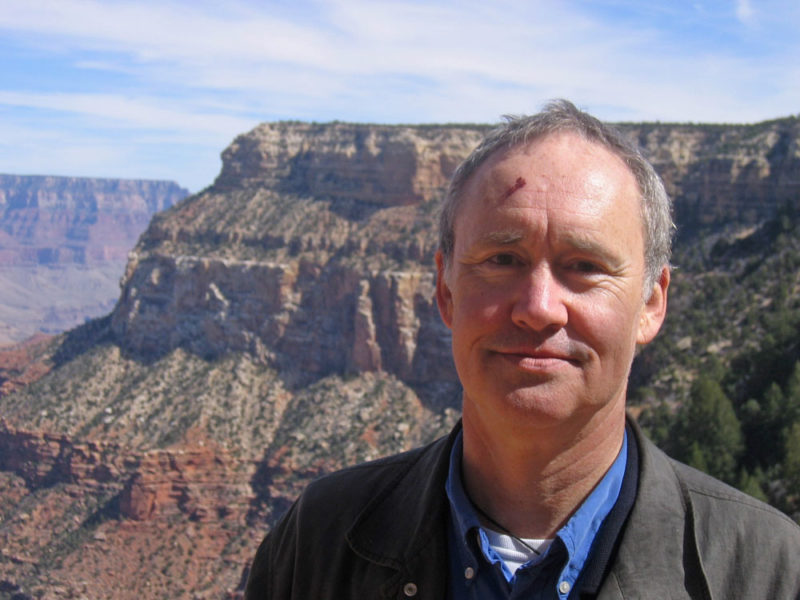
The first thing to say about staying a few nights on the rim of the Canyon is that despite it looking so bakingly sunny in all the photos, you are eight thousand feet above sea level so it is pretty cold up there. I had come unprepared, expecting to get by with walking boots, shorts and T-shirts, so I had to buy a coat and hiker’s hat from the store. If you think of the Canyon Village at the south rim as a sort of ski-resort without the skis, you wouldn’t be far wrong. The accommodation is fairly basic; groups of wooden chalets among the pine trees, with clonky old heating systems and a shop and canteen area. Nowhere is there what one might call a ‘gastronomic’ restaurant. There is one actual hotel up there – the El Tovar – but even that has a log-cabin style, with open fires and racks of coats on hangers in the lobby.
Let me apologise, at this point for being a complete Euro-snob when it comes to American food and drink. Especially coffee. It’s funny isn’t it, how, when it comes to that essential morning kickstart, the Americans will give you free refill after refill, as if determined to prove that quantity not quality is what really counts. Whereas in Italy, one queues for a teaspoonful of black sludge which is downed in one swallow and yet one remains satisfied for the rest of the day. You see it all depends on what one calls coffee. To an American, I suggest, a cup of coffee is something akin to the water you squeeze out of a dishwashing cloth. So, for a serious caffeine addict such as myself, it was disappointing to discover that, unlike a ski-resort in, say, Switzerland, it was proving impossible to imbibe an appropriate amount of caffeine in the morning without glugging down nine or ten cups of slosh.
However, the Grand Canyon Experience is not about sitting around drinking and eating, it is about getting up early, getting out there and walking. It is not really a good idea to try to get to the bottom and back again in one day, you might dehydrate and die. There are camps down there, best booked in advance, for the serious walker; but remember it is hot at the bottom; forty degrees at night! You can also, if you are completely insane, amble down on a mule. Many of the downward trails go perilously close to the edge and the thought of sashaying from side to side on some old nag, suspended over a thousand foot precipice did not appeal to me. It is all very well being told that one of these ‘burros’ has never lost its footing, but you would have several bumpy hours to consider the possibility that there is always a first time.
There are plenty of well marked half-way walks and also walks along the rim. Everywhere are warning signs about carrying enough water with you, and also about not going off the trail. Each year, apparently, there are several deaths of people who went just that bit too close to the edge to try and get a better holiday snap. Despite these warnings many people were clambering onto precarious overhangs, digi-cam in hand. Mad; because the Canyon is basically a load of crumbling rock. There are huge crags of it just suspended in time, about to tumble. Mind you, it would be interesting to know when was the last time one of these teetering boulders actually fell. Was it one of those merest blinks of geology, like, two hundred thousand years ago? Or was it in fact last September? Was someone standing on it trying to make a home video?
Once you enter the Canyon National Park there is a free shuttle bus service which takes you around the rim, dropping off at all the different chalets and recommended sunset viewing points. Some of these viewing points are better than others; I found ‘Hermit’s Point’, at the western end, too crowded with chattering tourists and preferred the, almost empty east end of the Park, at ‘Yavapai’ and ‘Mather’ Points where, it seemed to me, you can see further anyway. Silence, or at least a bit of quiet is fairly important I think, when contemplating the eternal, so school groups or clusters of Japanese teenagers were best avoided. Watching the Canyon change colour as the sun goes down and the shadows change shape is a truly magical and meditative experience, best enjoyed in tranquillity. And I’d like to be able to say that that was the reason I didn’t go on the helicopter trip round the rim. There is currently a heated debate about the amount of light aircraft flying around the Canyon, spoiling the peace for those on the ground, and it’s true that at certain times of day, they do buzz by every minute or so. I had pre-booked my helicopter trip from England and so was unaware of just how intrusive they are. However, on the day, I lost my re-entry ticket to the National Park and so driving out to the heliport would have meant paying again to re-enter. Not wanting to disturb the peace of others, I was glad that sometimes being a bit disorganised can get one out of the odd moral dilemma.
Having had my spirits thoroughly rejuvenated at the Canyon, it was a good idea to break the journey back to Phoenix with a stop at the little known and hardly lived-in town of Jerome. Once a ghost town, Jerome even now has under five hundred inhabitants. It is sitting, up a solitary hill, in the plain next to Sedona, where the famous, cowboy-film rocks stick up in funny shapes. All along the road are man-sized, Desperate-Dan cacti with arms bent at the elbow. If you’ve seen a lot of Westerns, this place will be very familiar.
Actually this is a problem going almost anywhere in North America; you feel you’ve seen it all before in the movies. Apart from the Canyon itself, which is without doubt the most impressive piece of scenery I have ever seen, most of the landscapes, people, roads and buildings on my trip were strangely recognisable to me. Each corner turned seemed to reveal another vaguely remembered scene from some late night TV film; each quirky waitress in every diner seemed unspecifically reminiscent. The amount of American movies and TV shows most of us digest, whether willingly or not, mean that one must get used to a daily dose of deja-vue.
But, for me, gasping by now for something stronger than a decaff Latte, Jerome was able to provide what I had been looking for all week. In a restaurant named after this old, mining town’s most famous former resident – Belgian Jennie’s ‘Bordello’ pizzeria – which was situated off ‘Husband’s alley’, not only did they serve good, home-made food, but they understood what I meant when I said, ‘Could I have a cup of coffee please?‘