Costa Rica

“Now I need a volunteer…”, said our forest guide, after leading us for an hour, deep into the shaded under-storey of the primary rain forest in Costa Rica. “…to eat the termites.” I pulled a face. The tour leaflet had made no mention of a tucker trial. “Naagel,” said the guide, “you are the one who is going to do it.” Never mind celebrity, just get me out of here, I thought. Our guide began to tap a little hole in the crisp brown termite’s nest which was suspended in a tree nearby. Sticking his fingers inside, he said, “you will see, they taste good.” On the end of his fingertips were three or four squashed insects which he pushed into the palm of my hand. “Kevin, I’m not at all sure about this…” I began.
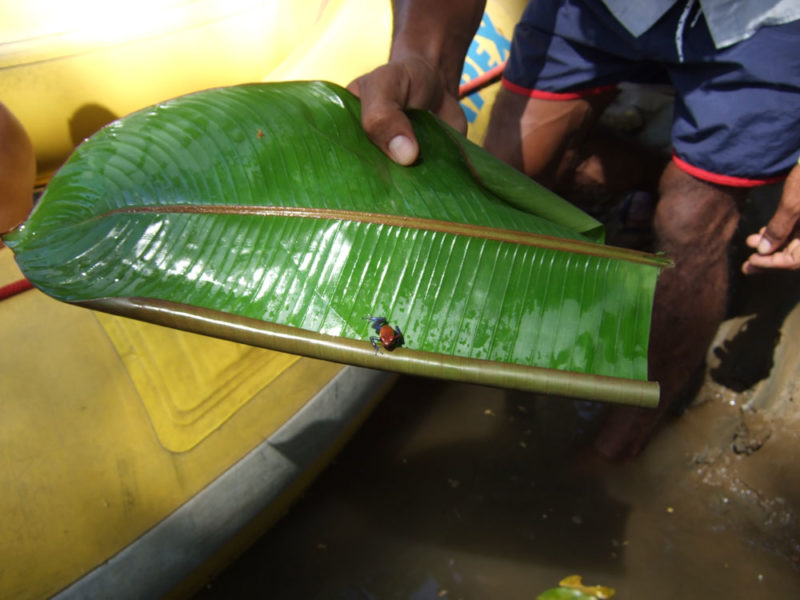
Not unusually for Costa Rica, our Hispanic forest guide had the very British sounding name of Kevin. For some unfathomable reason, many Costa Ricans seem to have names from the Home Counties. During my stay, I encountered a William the waiter, Roger the fruit seller, Raymond the taxi driver and Ryan the pharmacist. I looked at the little squished termites on my palm. Could I trust Kevin? Over the last week, we had followed him over wobbly hanging bridges suspended above the jungle floor of the Carara National Park, floated with him on rafts past dozens of fat crocodiles on the San Carlos river. We had learned not to touch certain poisonous tree barks, to look carefully under giant palm leaves for tiny, bright red toxic frogs. “Don’t lick them.” Kevin had warned. As if. Our day on the beach at the Manuel Antonio National Park amongst the raccoons, monkeys and iguanas had been almost like a normal holiday until some American kids had come across a long, pale green ‘eyelash snake’ in a playful mood. “Get back, get back.” Kevin had said quietly but urgently as we crowded around with our cameras zoomed to max.
But I’m wrong to make it sound as though my trip to Costa Rica was one long ordeal of jungle terror. We had also seen, in a short space of time, two and three-toed sloths, a family of snouted Coatis, and a colony of howler monkeys, who reputedly have the loudest grunt of any known mammal – sounds like a chain saw in a biscuit tin. And this is before even mentioning the birds. Here, I feel I must make a confession. I can be a bit of a twitcher. I’m not a full blown Oddie, but in my time I have done a fair bit of birding. And I can say without hesitation that bird-wise, Costa Rica is the best yet. Not only are there more bird species in a smaller area than just about anywhere else on earth – eight hundred and fifty odd – but, because of the rain in Costa Rica, of which there is a lot, it is actually Ok to wear an anorak. Obligatory even.
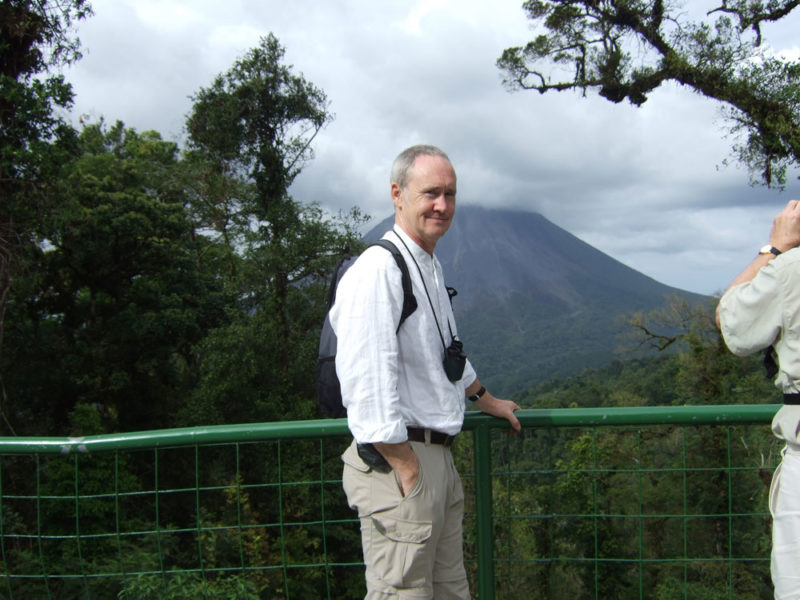
They say there are two kinds of weather in Costa Rica – rain and slightly less rain, but I found this to be a bit on the pessimistic side. Some days were gloriously hot and sunny for at least two hours before a short, hot tropical shower would come and drench one again, so getting wet was all part of it. And the clothes dried out in seconds once the sun came back out again. In fact, although Costa Rica is a mere three hundred miles from North to South and one hundred and seventy five from west to east – about the size of the Home Counties coincidentally enough – its position as the ‘land-bridge’ between the two Americas, and its creation, millions of years ago by the shifting tectonic plates mean that it has more micro-climates in a smaller space than anywhere else on earth. From cold cloud forest to hot dry plains, from the alpine freshness of the La Paz waterfall, with its proliferation of butterflies, to the foreboding steaminess of the active Arenal volcano, still fizzing and smoking from its last major eruption in nineteen sixty-eight.
At the beautiful Villa Lapas lodge hotel, which straddles a tributary of the Tarcoles river with its own little wobbly bridge, there is an exciting amount of bird life all around you, including the large Scarlet Macaw, or Lapas, after which the hotel is named, and, my favourites, the Chesnut-mandibled Toucans, who make a lovely clacking noise as they try not to bump into trees with their enormous, brightly coloured beaks. But those with binoculars – and it would be insane to go to Costa Rica without any – can enjoy Kiskadees, Orioles, woodpeckers, and the rest. On just one morning trip down the river Tarcoles I spotted thirty nine species which were new to me. But the bird for which Costa Rica is most famous is the Quetzal, or to give it its deserved full name, the Resplendent Quetzal; a large red and green bird which seems to be dressed in enormous velvety robes. This is the one on the cover of many Costa Rican guide books and like much of the wild life is now under threat of extinction. Unfortunately, there is a similar story all over Costa Rica; from the turtles on the Caribbean coast who get confused by the lights of new beach hotels when trying to visit their customary egg laying sites, to the monkeys near Puntarenas on the Pacific who now suffer from high cholesterol from packaged food they have stolen or been given by tourists for a photo opportunity.
Luckily, the Costa Rican government are enlightened when it comes to the environment and have designated twenty five per cent of the entire country to the National Parks. Much of the forest was cleared in the sixties for cattle farming, but nowadays farmers get compensation for not cutting down the trees. Nevertheless with the boom in tourism and the proliferation of condo-building for, mostly American, investment speculators, these parks are fast becoming isolated islands of nature, and many species, cut off from their normal habitats are now endangered. So there is now talk of creating environmental ‘corridors’ linking the national park areas so that the eco-system can remain intact.
Rationalising that I would be becoming part of a natural eco food-chain, I took a deep breath and swallowed the termites; they tasted disgusting – bitter and earthy – and I started to spit. Kevin had already moved on and was cutting a small twig from what he called an ‘anaesthetic’ tree. He told me to chew on it which I did, and within seconds my tongue and whole mouth were tingling as if I had had a shot of novocaine at the dentist. The taste of termites was gone in an instant. This little bit of twig was just one example of the as yet untapped uses of rainforest resources. In fact, the medicinal properties of Costa Rican flora is also something the government are keen to promote, and here again they seem to have adopted a forward looking policy, securing international investment for biological research into plants as yet unheard of.
I just hope that it is not too late for somewhere as unique as Costa Rica; on the river rafting trip, as we drifted silently amongst the unspoilt landscape, there was only one sign of the modern world – apart from ourselves of course. And that was the hundreds of shredded plastic bags, hanging off the mangrove branches looking like the lynched corpses of exotic birds. So, it’s true, I thought, these shreds of plastic will still be around millennia after we have all gone. On my return I have sworn to try and give up single use plastic bags for good.